
Congratulations to our Swiss Graduates!

We’re thrilled to celebrate the success of our talented students from the Swiss team who have completed their Master’s and Bachelor’s theses at the University of Fribourg, utilizing data collected within our project in Switzerland.
All the students graduated from the University of Fribourg (Switzerland) and participated in various stages of the TIMED work packages.
Master of Science (MSc) in Psychology
· Chloé Barbey
· Nahiara Ibarolla
· Laetitia Merian
· Camille Rossat
· Alexandra Walther
· Maira Brullo
· Anaïs Orsat
· Théo Sahagum
· Shayma Hammal
Specialized Master of Science (spMSc) in Digital Neuroscience
· Diogo Rocha Moreira
Bachelor of Science (BSc) in Psychology
· Mattia Richter
· Inès Romanens
· Giulia Sergiu


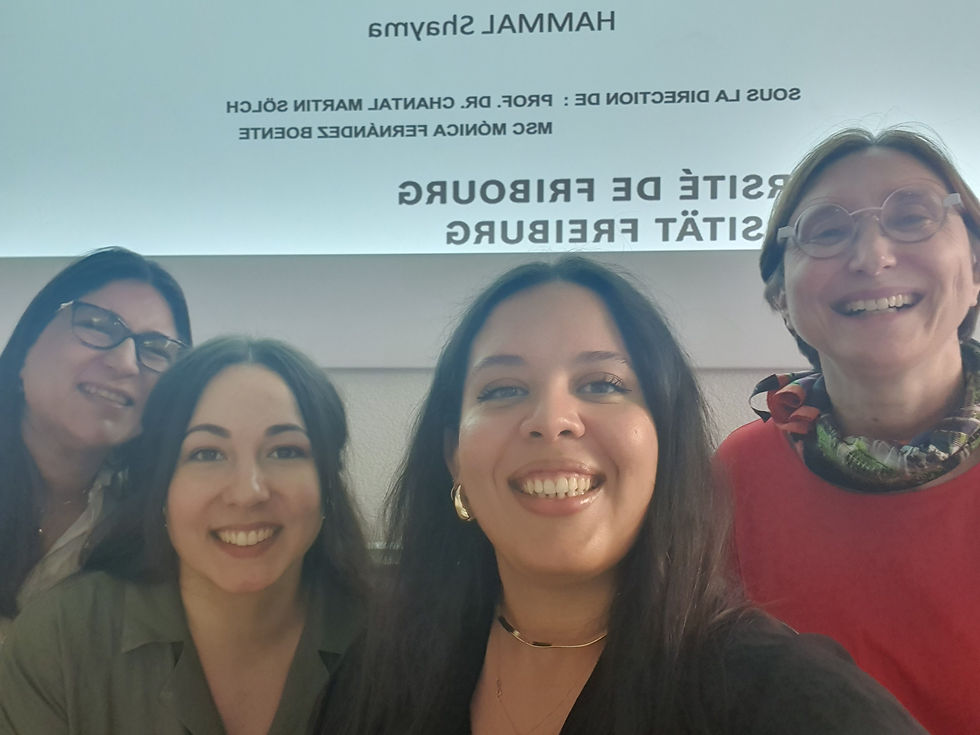

We also extend our thanks and best wishes to those whose theses are still currently in progress: Valentina Facchi Negri, Belinda Rapin and Rebecca Porchet. We look forward to seeing the final results of your research!
As our graduates embark on new journeys, we wanted to celebrate their accomplishments and look forward to their bright future.
Below are brief introductions of some of those who wanted to be showcased on the website and a summary of the remarkable and varied work they’ve done within our research consortium in the Swiss team.
Thank you all again for you contributions, hard work and commitment!
All the best for what’s next!
Students introductions and thesis abstract
Chloe Barbey

Personal Summary
My name is Chloe, I’m from Fribourg (Switzerland) and I had the opportunity to contribute to the TIMED project. I have been studying Clinical and Health Psychology at the University of Fribourg for the past six years, where I recently completed my Master’s degree. In my Master thesis linked to the TIMED, I explored how digital technologies impact work-life balance, with a particular focus on the stress caused by work-related tools when they spill over into private life. My research showed how these tools, while offering flexibility, can also blur boundaries and reduce well-being. I am passionate about mental health and interested in how we can better regulate the use of digital technologies to protect quality of life and preserve balance between work and personal time.
Thesis Abstract
Digital technology, increasingly present and sophisticated, is transforming work practices and raising challenges regarding the work-life balance. This study explores the various influences of digital technology on this balance through semi-structured interviews. A thematic analysis based on the discourse of 25 participants was conducted, revealing 11 themes and 38 sub-themes. The results indicated that digital work-related tools used in personal life may contribute
to stress and reduced well-being, according to participants' accounts. Furthermore, the collected data suggest that flexible work arrangements, among participants aged 18 to 30, might blur the boundaries between private and professional spheres. Remote work appears to have mixed effects on work-life balance, offering greater ease in daily organization while also contributing to the blurring of these boundaries. This study reveals the need to regulate the use of work- related digital technologies in order to preserve quality of life and mental health.
Laetitia Merian
Personal Summary

My name is Laetitia Merian, and I recently graduated from the University of Fribourg (Switzerland), where I completed a Bachelor’s degree in Psychology followed by a Master’s degree in Clinical and Health Psychology. My Master’s thesis was carried out within the third Work Package of the Project TIMED. I chose to focus my research on gender differences in parental leisure time. Specifically, I examined whether there were gender differences within the Swiss sample regarding the distribution of parental responsibilities, feelings of guilt when parents take time for themselves without their children, the perceived burden during leisure time, and whether one gender has greater access to personal leisure time than the other. My aim was to contribute to the ongoing debate about how parental responsibilities are shared between mothers and fathers. This topic felt particularly meaningful to me, as during my internships working with families, I observed how mothers often continue to carry a disproportionate share of childcare responsibilities, with significant consequences for their mental health.
Thesis Abstract
This qualitative study explores gender differences in the experience of leisure time among parents with at least one child under 18 years old. Previous research shows that mothers generally have more limited and lower-quality leisure time than fathers. To further investigate this issue, nine semi-structured interviews were conducted with mothers and fathers living in Switzerland. The thematic analysis focused on several aspects likely to influence this experience: the division of household and parental tasks, feelings of guilt associated with leisure time spent without the children, mental load during leisure moments, and whether leisure activities were shared with the children or not. These dimensions appear in the narratives of both groups, except for the mental load, which is generally little mentioned. The results reveal similar experiences between genders, both considering parental responsibilities as a constraint on leisure time. This study, which finds few gender differences, nevertheless highlights the significant impact of parenthood on the way leisure time is experienced.
Keywords: parenthood, leisure time, gender differences, qualitative analysis
Camille Rossat
Personal Summary

My name is Camille Rossat, and I recently completed my studies in Clinical and Health Psychology. I carried out my Master’s internship at the association Pont Universel, where I led group workshops combining art and psychology, two areas that strongly interest me. Completing my Master’s thesis within the international TIMED project introduced me to qualitative methods and interview techniques, and also gave me the chance to meet renowned researchers. Through this experience, I discovered the field of psychological research on time perception – a topic that was entirely new to me and that I found both fascinating and enriching.
Thesis Abstract
This qualitative study examines the influence of emotions on the perceived speed of time during leisure and work. It is part of the TIMED project, an international project which aims to examine the impact of technology on the perception of time. Twenty-five Swiss adults took part in one-hour semi-structured interviews; the interviews were then transcribed and coded. Thematic analysis revealed 11 themes and 38 sub-themes, three of which were selected for this study: perception of time, feelings about free time and feelings about work. Participants associated leisure with predominantly positive affects (relaxation, pleasure, freedom) and with a sense of accelerated time. Emotional valence, arousal, cognitive load, and task engagement appear to shape judgements about the passage of time. Moreover, positive emotions could contribute to an acceleration of these judgments. These findings support approaches that foster engagement in fulfilling leisure activities and a healthy work–life balance. This qualitative study thus provides a better understanding of the participants' temporal experience in different areas of life. Further research is needed to deepen and generalize these results.
Keywords: time perception, passage of time, emotion, leisure
Alexandra Walther
Personal Summary

Alexandra changed careers when she was 34 years old. She opted for Psychology, because she wanted to provide care through listening, speaking, direct contact and true and deep relationship. She therefore resumed studies while working part-time in the psycho-social field. Today, Alexandra obtained her Master’s degree in Clinical and Health Psychology and is looking forward to starting the MAS in Psychotherapy. What fascinates her is both the diversity and richness of the people she supports, but also the common trends. All as similar and as different!
Thesis Abstract
This work questions frustration and guilt in relation to self-control strategies of the use of digital technology. The qualitative approach is based on the analysis of 25 interviews in the framework of TIMED, a project between six countries on the impact of digitalization over time. Assumption 1 postulates frustration and/or guilt in response to digital technology. Four participants attest it. Assumption 2 is about frustration and/or guilt reactions to the loss of control over the use of digital technology. 12 users evoke unpleasant emotions as a reaction to their loss of control. The assumption 3 advances that participants adopt strategies of self-control over digital technology following their frustration and/or guilt as users. Almost all participants have at least one strategy to increase their self-control in conjunction with unpleasant emotions. However, as with assumption 2, emotions are not specifically named. The present work concludes on the need to explore further the research paths proposed by this study. A better understanding of the interactions between frustration, guilt and self-control strategies could lead to new therapeutic practices for people suffering from their use of digital technology.
Keywords: guilt, frustration, digital technology, strategy, self-control
Diogo Alexandre Rocha Moreira
Personal Summary

I am Diogo Alexandre Rocha Moreira, a graduate of the spMSc in Digital Neuroscience at the University of Fribourg (UNIFR). With a Bachelor’s in Biomedical Sciences, my academic background combines physiology and machine learning, and my research interests include brain-computer interfaces (BCI) and brain signal translation. Having grown up with digital technology, I am particularly interested in its influence on many aspects of life. I joined the TIMED project for the possibility to apply machine learning algorithms to a large, cross-cultural dataset and to explore how digitalization influences well-being and time experience. Looking ahead, I am eager to further develop my programming skills and design scalable data analysis pipelines that can be applied to neuroscience experiments and BCI research.
Thesis Summary
My master’s thesis, Predicting Psychological Outcomes of Digital Life: A Machine Learning Analysis on European Data, investigated how digitalization influences well-being and perceptions of time across six European countries. Using data from TIMED’s Work Package 2, which included demographic information alongside questionnaires on time, digital technology use, and well-being, I applied machine learning methods to predict psychological distress and time pressure. The large sample size promotes machine learning over classical statistics to capture complex interactions among variables and explore many features automatically. A comparison of regression models showed that decision tree-based ensemble methods, particularly boosting algorithms, outperformed both bagging algorithms and the linear regression baseline. Through model-agnostic interpretation techniques such as SHAP values, I identified a clear positive association between problematic Internet use and psychological distress, in line with established cutoff points. The analyses also revealed that the influence of digitalization measures varied significantly across countries. Although effects on time pressure were generally small, they still exhibited cross-country differences. Overall, the results highlight that boosting algorithms outperform linear regression for this type of psychometric data, offering nuanced insights into the psychological outcomes of digital life.
Keywords: Machine Learning, Regression, Psychological Distress, Time Pressure, SHAP
Maira Brullo
Personal Summary

My name is Maira Brullo, and I am from Canton Ticino, one of the Italian-speaking regions of Switzerland. In September 2024, I obtained my Master’s degree in Clinical and Health Psychology from the University of Fribourg, Switzerland. As part of my studies, I was a member of the Swiss team for the TIMED project, focusing my thesis on the presence of technostress in the workplace, particularly within intellectual and administrative professions. Through a qualitative study, I explored the impact of evolving digital practices on professional environments and the strategies employed to mitigate technostress. Currently, I am working at Ingrado, a drug addiction service in Canton Ticino, as part of my training to become a psychologist.
Thesis Abstract
The study examines the perception of technostress in the workplace among participants with an intellectual or administrative profession, as well as their use of coping strategies. According to several authors, there are five types of technostress indicators: techno-invasion, techno-overload, techno-uncertainty, techno-insecurity and techno-complexity. The study is part of the European TIMED project, which is taking place in six countries and explores how people use digital practices. Based on 51 semi-structured interviews, qualitative data were collected to look for indicators of technostress in the participants' discourse, and were then analyzed thematically. The majority of participants reported feeling the presence of technostress in their discourse, in particular through the indicators of techno-invasion, techno-overload and techno-complexity. In addition, only participants with an intellectual profession report perceiving a change in the way they work, and they use strategies to adapt to technostress. This study concludes by highlighting the value of future research in this field, using empirical scales to measure the presence of technostress in these professions. Intervention strategies must be adopted by organizations to improve the professional well-being of their employees.
Keywords : technostress, information and communication technology, work-life balance,
intellectual professionals, administrative professionals
Anais Orsat
Personal Summary

Originally from France, my journey to becoming a psychologist was marked by detours and resilience. It was ultimately at the University of Fribourg, Switzerland, that I was able to complete this adventure. It was as part of my master's degree in Clinical and Health Psychology that I joined the European TIMED project. After a memorable internship in the field of addiction, it was only natural that I turned my attention to the addictive aspects of digital technology use. My research focused on indicators of problematic digital technology use among young adults, in light of the diagnostic criteria for online gaming disorder. Today, I aspire to continue my professional career in the fields of psychopathology and addiction.
Thesis Abstract
Given the widespread presence of digital technologies, their problematic use among young adults is attracting increasing interest in research due to its impact on mental health and social behaviors. This qualitative study, based on semi-structured interviews, explores such manifestations in 29 young adults (aged 18–29), using the diagnostic criteria for Gaming Disorder and Internet Gaming Disorder as defined by current classification systems. The aim is to identify the presence of these criteria in everyday digital practices unrelated to online gaming, and to explore the underlying motivational factors. Through a thematic analysis of semi-structured interviews, the findings reveal variable presence of gaming disorder criteria, with motivations such as boredom or escapism frequently mentioned. These results highlight the need for rigorous assessment of diagnostic criteria to avoid over-pathologization, while raising awareness of the risks associated with excessive use of digital tools. This study paves the way for further research on the impact of digital practices on mental health and the socio-cultural factors shaping such behaviors.
Keywords: problematic use of digital technologies, young adults, ICD-11 / DSM-5, motivational factors, qualitative analysis, gaming disorder
Théo Sahagum
Personal Summary

My name is Théo Sahagum and I come from Auvergne, a region of France. After a Bachelor's degree in Psychology (UCA and Lyon II, France), I obtained, in February 2025, a Master's degree in Clinical and Health Psychology at the University of Fribourg (Switzerland). During my studies, I was part of the TIMED team, and I did my Master's thesis on the effects of digital technologies on attention and time perception. Currently, i deliver psychological services for the Eliezer Association in the canton of Valais, Switzerland, which is specialized in neurodevelopmental disorders.
Thesis Abstract
This study examines the impact of digital technologies on attention and time perception, particularly among young adults (18-25 years old). Based on a thematic analysis of 51 semi-structured interviews, the study explores, through the participants’ discourse, the negative effects of digital practices such as multitasking, informational overload, and cognitive absorption on processes related to attention, time perception, and cognitive load. The findings reveal that digital multitasking and informational overload fragment attention and diminish the ability to sustain prolonged focus. Furthermore, participants also report effects on their perception of time, often linked to states of cognitive absorption induced by social media and video games. Finally, the informational overload caused by digital technologies disrupts participants’ attention and time perception, leading to the emergence of negative emotions and frustration. This study highlights the need to promote better management of digital practices and encourages the implementation of self-regulation strategies.
Keywords: digital technologies, attention, time perception, cognitive overload, digital multitasking, cognitive absorption, young adults
Mattia Richter
Personal Summary

I completed a Bachelor's degree in Psychology at the University of Fribourg, Switzerland. During my thesis, I collaborated with the TIMED research team, focusing myself on the relationship between problematic internet use and loneliness. My academic interests span clinical psychology, neuroscience, and informatics. Currently, I am pursuing a research internship at Unispital in Basel.
Thesis Abstract
In recent decades, the expansion of new digital technologies has raised growing concerns about the possible emergence of a new phenomenon linked to problematic internet use (PIU). The aim of this study, part of the European project TIMe experience in Europe's Digital age (TIMED), is to explore the relationship between feelings of loneliness, social isolation, and PIU. Initially, the presence of PIU was measured using the PIUQ-9 questionnaire (Laconi et al., 2019). Next, a mobile application developed as part of the TIMED project was used to implement an Experience Sampling Method (ESM) study, collecting self-reported questionnaires assessing feelings of loneliness and social isolation four times a day for a week. The results suggest that PIU positively predicts feelings of loneliness, but not social isolation. Exploratory analyses also suggested a positive influence of social isolation on feelings of loneliness. These results suggest an important role for feelings of loneliness in the manifestation of PIU and a possible indirect role for social isolation.
Keywords: Social isolation, PIU, PIUQ-9, Loneliness, Problematic Internet Use

Finishing a Master’s thesis is a big milestone, and the last few practical details can feel strangely important after months of research. Checking the university’s formatting rules before sending the final file to print is one thing I’d definitely recommend. Cover style and thesis hard binding requirements can vary, so leaving that until the final day seems risky. It’s good to see these graduates reaching the finish line.