
Closing the TIMED Project: Key Findings, Tools and Resources
Updated: Jun 2
With the CHANSE-funded TIMED project now concluded, we are pleased to share a set of findings, tools and resources that reflect the breadth, ambition and collaborative strength of the project’s work on digital life, wellbeing, time and everyday experience across Europe. Bringing together researchers from across disciplines and countries, TIMED created a rich body of work that moves from conceptual innovation and measurement to policy relevance, public-facing communication and support for future research communities.
A policy brief for healthier digital futures
At the centre of these materials is the policy brief Understanding Digital Life for Healthier Digital Futures (here), which offers an accessible overview of some of TIMED’s main findings and recommendations. Drawing on research with more than 15,000 participants across the United Kingdom, Spain, Germany, Poland, Switzerland and Czechia, the brief highlights why understanding digital life requires moving beyond screen time alone and paying greater attention to the quality of people’s digital experiences. It also brings together recommendations relevant to future policy and regulation, making it an especially valuable starting point for readers who want to engage with the project’s broader contribution and its relevance beyond academia.
New tools for measuring digital life
A second major outcome of the project is the development of two new cross-culturally validated measurement tools: the Immersion in Digital Life Scale (IDLS) and the Quality of Digital Experience Scale (QDES). These tools (available below)
were designed to capture not only how much people use digital technologies, but also how deeply digital technologies are embedded in their daily lives and how they contribute to wellbeing, social connectedness, and time and efficiency. Available in six languages, the scales provide new ways for researchers, policymakers, organisations and individuals to assess digital life in more meaningful and nuanced ways. The original studies on the development and validation of the scales, including their language versions, can be accessed here and here.


Digital Work and Gender Inequality
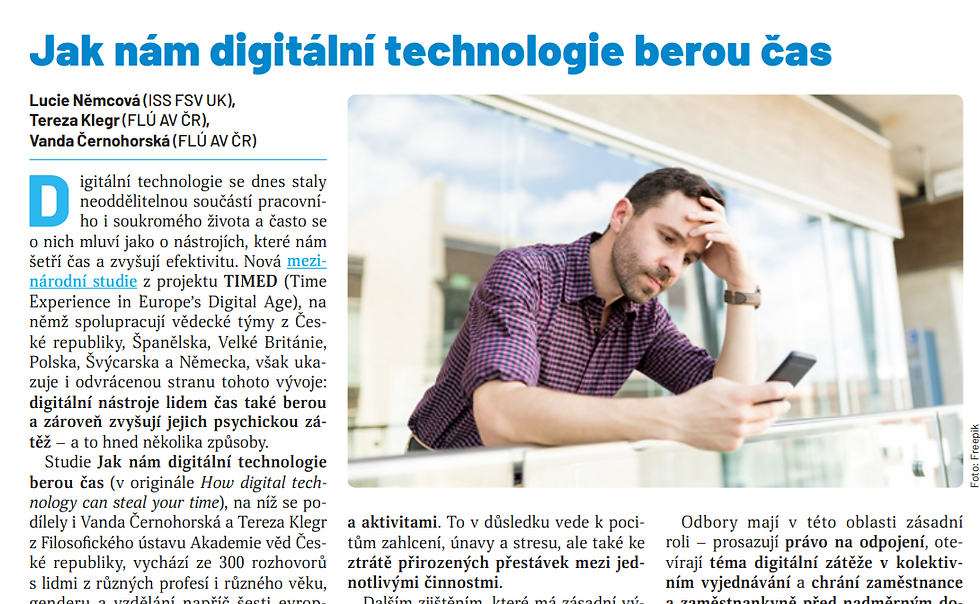
The project also generated important findings on the relationship between digital technology use, work-life balance and gender inequality. Based on 450 interviews and a survey of 7,536 adults across six European countries, the infographic (below) summarises how digital technologies can blur the boundaries between work and personal life through constant reachability, asynchronous communication, intensified workloads and the loss of deep work. It also draws attention to the unequal burden carried by caregivers, most often women, and points towards structural responses such as the right to disconnect, legal protections for flexible remote work, and greater recognition of unpaid care and domestic work. These insights are also presented in a short video here:


Experimental Insights into Digital Breaks
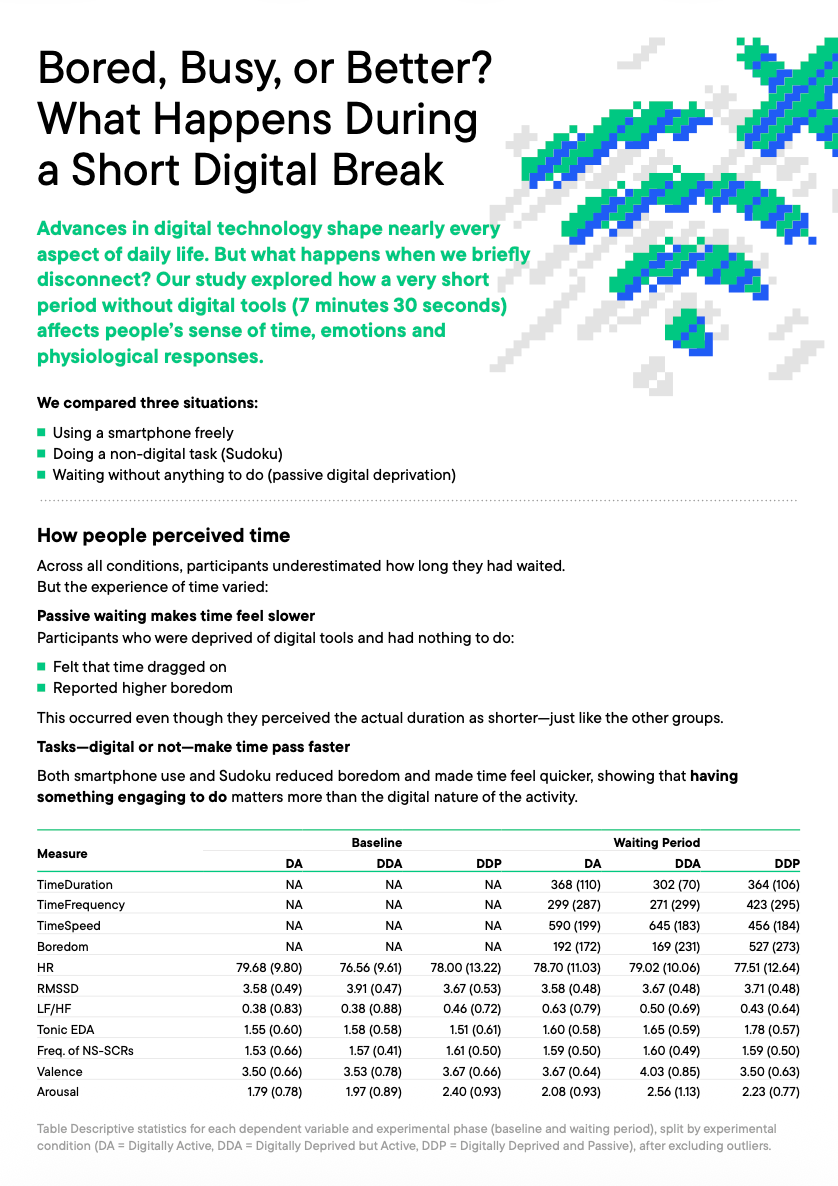
TIMED also included experimental research exploring how a brief period without digital tools shapes people’s experience of time, boredom and emotion. Comparing smartphone use, a non-digital task and passive waiting, the study found that passive waiting increased boredom and made time feel slower, while engaging in a task made time pass more quickly. At the same time, the non-digital task was associated with more positive emotional outcomes than smartphone use. The results suggest that the benefits of a digital break depend less on simply avoiding technology and more on whether the alternative activity is engaging and mentally absorbing. Readers interested in this topic can consult the original study publication here.

Further TIMED Publications
In addition to the outputs highlighted here, TIMED has also generated a wider body of publications that further develop the project’s central themes. Recent work has explored the relationship between problematic internet use, psychological distress and life satisfaction (here), the subjective passage of time in the digital era (here), chronic time pressure as a predictor of symptoms of depression, anxiety and stress (here), and the ways in which digital technology can contribute to experiences of lost time, guilt and reduced control (here). More publications are also forthcoming, and will continue to build on the project’s contribution to understanding digital life across Europe.
A good practice case from the TIMED spring school
Alongside these research findings and tools, we are also sharing a good practice case based on the TIMED spring school Interdisciplinarity in DigiTech Research: From Ideas to Action, organised in Prague in April 2024 by the Institute of Philosophy of the Czech Academy of Sciences. Bringing together nearly 50 early-career researchers from across Europe, the spring school focused on interdisciplinary approaches to digital technology research and explored themes including research ethics, funding, ethnography, creative methods and career development. As a project output, this publication (below)
documents one of TIMED’s most collaborative and forward-looking activities, highlighting the project’s commitment not only to producing research, but also to creating spaces for exchange, learning and future cooperation.
Taken together, these outputs reflect the range of TIMED’s work: from conceptual and methodological innovation to empirical research findings, policy relevance and support for future research communities. They also reflect the strength of the international and interdisciplinary team that made the project possible. We hope these findings, tools and resources will continue to be useful to researchers, policymakers, practitioners and all those interested in healthier and more inclusive digital futures in Europe.

It’s great to see the TIMED project wrap up with such a strong focus on translating conceptual work into practical measurement tools—especially the cross-country angle on digital wellbeing. I’ve been digging into the policy briefs and would love to see how the survey instruments hold up in non-European contexts, so check out the resources page for https://hyros.pro
The range of outputs here—from conceptual framing to measurement tools—really shows how much groundwork TIMED laid for cross-European comparisons of digital time use. I’ve been digging into the policy-relevant resources myself, and the practical angle is exactly what I needed for my own work. https://magicbrief.pro
The emphasis on moving from conceptual innovation to actual policy relevance is exactly what cross-European collaboration should strive for—glad to see the tools are openly available. I’ve already started digging into the measurement resources, and the practical angle is a huge plus. Check out the project’s findings page for the full breakdown. https://photo-generator-ai.com
The emphasis on moving from conceptual innovation to policy relevance really stands out—especially how the cross-country collaboration shaped the measurement tools. I’ve been digging into the resources section myself, and the practical frameworks are a great starting point for anyone working on digital wellbeing. Check out https://musevideo.site
The cross-country, interdisciplinary angle really comes through in these findings—especially how time and wellbeing get measured so differently across contexts. I’ve been digging into the policy-relevant tools myself, and the way they bridge conceptual work with practical application is exactly what I needed. Check out the resource hub for the full https://dreamina-ai.pro